What Paper Intake Forms Cost Your Practice

Before Design by Cristina, before Clarafide, I ran my own spa.
Aqua Pura wasn't a big operation. A dedicated treatment room, a handful of regular clients, the kind of practice where you know everyone's skin history because you're the one who's been tracking it, appointment after appointment.
That little spa is still in my home, and I still love it. I love what I created there and what it represents. I don't really practice esthetics any longer, but running Aqua Pura taught me something I didn't expect: I was much more drawn to everything happening behind the service.
I loved creating the space, building the website, shaping the client experience, and figuring out how all the pieces worked together. When something felt clunky, I wanted to fix it. When I couldn't find what I wanted, I wanted to build it.
Aqua Pura helped me figure out what kind of work I loved. I'm a behind-the-scenes person. I'm a designer. I love creating. I love building.
And one of the things I kept wanting to make better was the intake experience.
The Form Everyone Filled Out the Same Way
Every new client filled out the same intake form: skin history, allergies, medications, what they'd tried before and hated. On paper, clipped to a board, handed over the second they walked in.
They'd fill it out in the waiting area, rushed, five or ten minutes before their appointment, often leaving questions blank because they didn't have time to think or didn't realize a question mattered. Nobody was being careless. They were being human.
A form handed to you cold, right before an appointment, gets exactly the level of attention that setting allows, which isn't much.
What I Caught Too Late
I'd catch the gaps during the appointment instead of before it. A medication I would have wanted to know about ahead of time. An allergy that would have changed what I planned to use. A detail that only came up once we were already talking in the treatment room.
None of these became dramatic emergencies. Most were simply things I could adjust for once I knew about them. But they added up to a pattern I couldn't ignore: I was collecting information before the appointment without necessarily getting the information I needed before the appointment.
The form was technically complete. The intake process wasn't.
Not because clients didn't care, and not because I wasn't asking the right questions. The way I was collecting the information was working against the information I wanted to collect.
Why the Paper Was the Problem, Not the Client
It's tempting to write this off as a client behavior problem: people rush, people skim, people forget.
But five minutes before an appointment isn't a particularly good time to ask someone to stop and think through medications, allergies, previous treatments, products, concerns, and everything else you want to know before you begin.
Paper can't do much to help.
It can't make the experience feel easier one question at a time. It can't give someone the space to answer from home when they aren't watching the clock. It can't make certain questions required before they move on. And it can't put those answers in front of you ahead of the appointment, when you still have time to actually use them.
That was the part that bothered me most.
I didn't just want a completed form. I wanted better information at a point when I could do something with it.
How That Shaped What I Built
When I started building Clarafide, I didn't design it around an abstract idea of "intake forms." I designed it around the room I used to work in and all those little moments when I wished I'd known something sooner.
The goal wasn't to take the same paper form and make it prettier on a screen.
It was to rethink the experience around both people using it: the client answering the questions and the provider who needs those answers before the appointment begins.
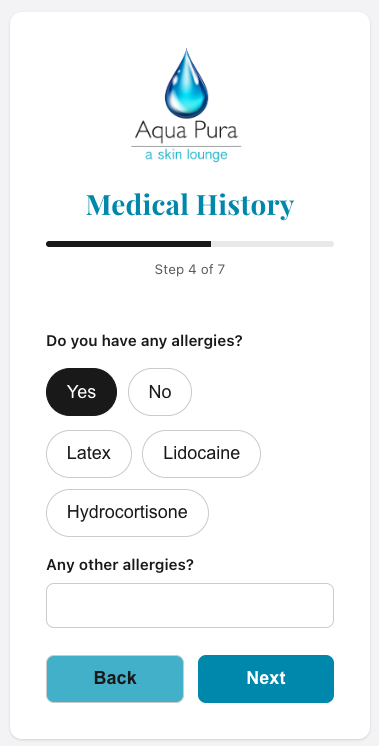
That's also why the live demo still runs on Aqua Pura's branding. It's the practice I know best, so it's the one I built the walkthrough around. The branding, the kinds of questions, even the feeling of the experience come from something real.
Aqua Pura helped me discover that the part of running a service business I loved most was building what happens behind the scenes.
Clarafide came from that.
Rather than reading about it, explore the live demo and see how it feels from your client's side.